
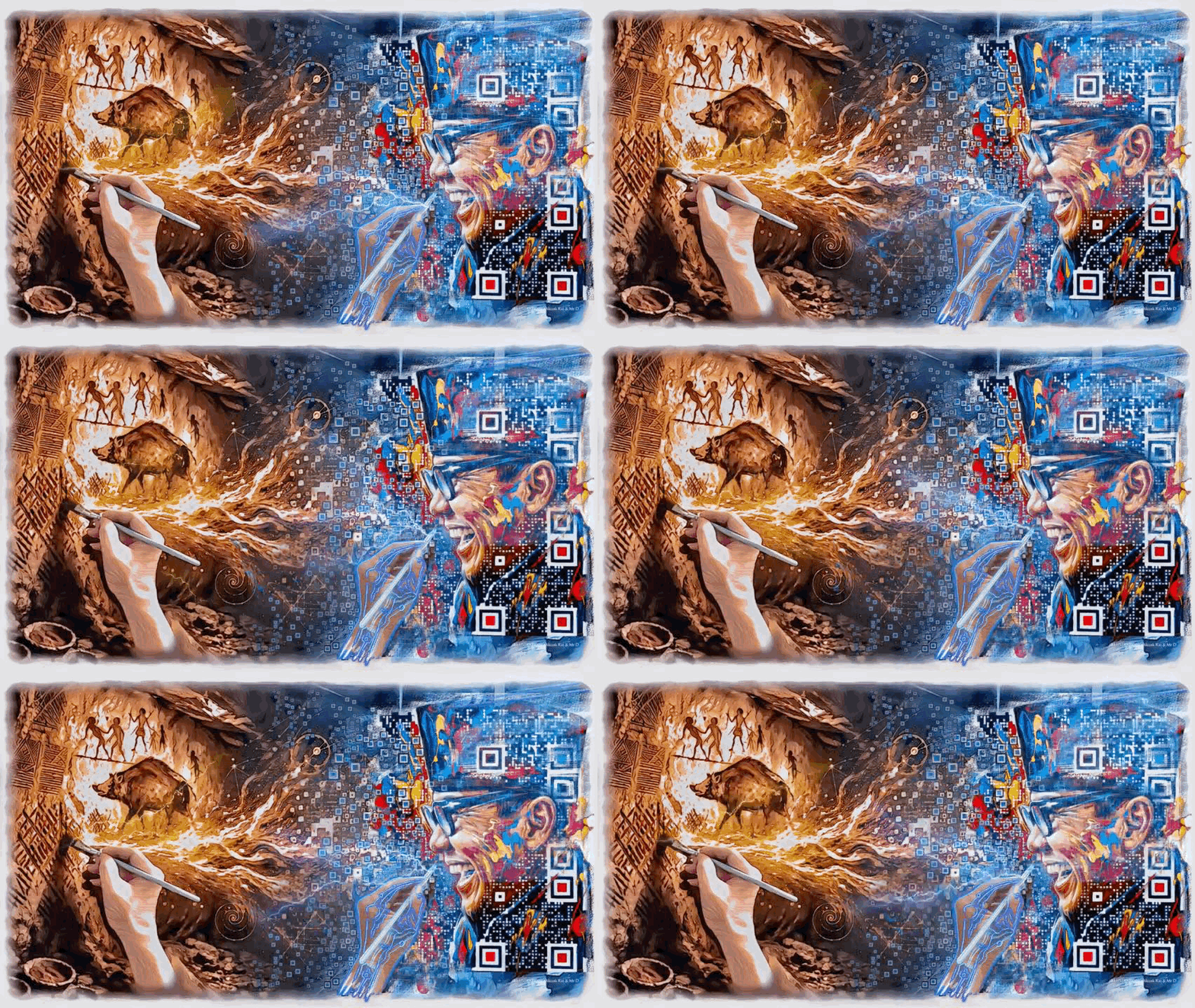
The Brush and the Matrix
Watch a fine-tipped brush dip into thick acrylic paint, slowly tracing a precise geometric square onto a completely blank canvas. There are no digital printers or mechanical stamps here. The artist behind the brush is Doddy “Mr D” Hernanto, and he is playing a high-stakes game against a machine. If his hand trembles by a fraction of a millimeter, or if the paint smudges, the digital matrix shatters. The code will fail to scan, and the entire artwork is ruined.
This artistic movement is called “Codeisme”. It represents a profound contemporary fusion of human expression and mathematical precision, the blending of a uniquely human surface with an irreducible functional kernel.
For decades, global education systems and innovation policies have championed STEM (Science, Technology, Engineering, and Mathematics) as the sole foundation of progress, treating art as a mere afterthought. STEM taught us how to manipulate matter and information, but art teaches us why certain forms matter to human beings. Codeisme demonstrates that STEAM is not the forced addition of aesthetics to engineering. Instead, it is the recognition that human civilization has always advanced through the simultaneous evolution of utility and meaning.
To understand where this convergence is heading, we must look through the lens of history at two great revolutions in how humans have stored and transmitted meaning: the revolution of the image, and the revolution of the code.
The First Revolution: Art as Our First External Memory
The drive to compress massive human experience into a tiny visual space did not start in a modern studio. Follow the red thread backward 73,000 years into the pitch-black tunnels of Blombos Cave, South Africa. There, an early human scratched a cross-hatched pattern into a rock with a raw piece of ochre crayon. It is the oldest known abstract drawing ever found.
More than 20,000 years later, on the opposite side of the world in South Sulawesi, Indonesia, early humans took this instinct further. In Leang Karampuang, in the caves of Maros-Pangkep, they painted human figures interacting with a wild boar—creating the oldest known evidence of narrative art on Earth, dated to at least 51,200 years old.
These ancient images were never mere decorations. They were humanity’s first information technology — our earliest external memory devices. They allowed early humans to preserve knowledge, intentions, and stories beyond the biological limits of individual memory or speech.
The Second Revolution: The Birth of the Code
The second revolution came much later, speaking the language of mathematics and circuitry rather than ochre and cave walls.
In 1948, engineer Claude Shannon at Bell Labs published A Mathematical Theory of Communication, laying the foundation for modern information theory. Shannon precisely formalized how complex information—whether text, sound, or an image—could be quantified, stripped down, compressed, and transmitted reliably across a noisy communication channel. Without his framework, the digital world of smartphones and data compression would not exist.
Half a century later, that mathematical principle took on a physical, visual form. In 1994, Japanese engineer Masahiro Hara invented the QR code to track automotive parts. Inspired by the black-and-white patterns of a Go board, Hara designed a two-dimensional grid capable of storing dense data that could be scanned from multiple angles at high speed. The QR code became a direct descendant of Shannon’s theory: a way of compressing meaning into an extraordinarily efficient visual pattern.
For decades, these two legacies traveled on completely separate paths—the narrative image living on museum walls, and the precise code living on digital screens and product packaging.
The Synthesis: Kernel and Surface
Mr. Doddy’s Codeisme sits exactly at the intersection of these two historical revolutions, bringing them into a unified metaphysical architecture.
In systems language, this relationship is defined as Kernel and Surface. Many complex systems in the universe—whether atoms, organisms, or a civilizations—are organized around an irreducible functional core (the kernel) embedded within a rich, expressive layer (the surface).
In Codeisme, neither layer dominates the other. The surface inherits the ancient instinct of Maros-Pangkep: fluid brushstrokes, rich textures, and raw human emotion. The kernel inherits the legacy of Shannon and Hara: machine-readable, functional code compressed within the composition. Function is preserved without sacrificing individuality; the painting remains completely scannable, and the code remains beautifully painted.
This synthesis is vividly captured in Mr. Doddy’s portrait of Bung Karno. A founding father is, in a very real sense, the historical kernel of a nation—the singular point of origin from which the immense complexity of a country’s culture, institutions, and collective narrative grows. By hand-painting a functional digital code into the face of the proklamator, Mr. Doddy has created a kernel within a kernel. It is data compressed behind the face of a man who was himself the compression point of Indonesian history.
The Next Horizon
If cave art externalized human memory, and digital codes compressed data transmission, the emergence of artificial intelligence introduces an entirely new layer to this trajectory. AI may soon externalize human interpretation itself. The digital layers embedded behind Codeisme works will likely evolve from static links into living, dynamic dialogues—allowing the artwork to transform from a static repository of meaning into an active participant in meaning-making.
Codeisme is not a passing technological trend or a digital gimmick. It is the logical continuation of humanity’s oldest instinct, rewritten in the vocabulary of the twenty-first century. It stands as one of the clearest contemporary expressions of the meeting of art and science, proving that we do not have to choose between human expression and functional utility. By holding the camera steady at the intersection of the brush and the code, Codeisme shows us a place where memory, transmission, and identity seamlessly coexist.
excelent digital art, innovation feel and full inspiration